

Ten years of SACA: conservation agriculture needs systemic support, not just individual measures


On 25 August 2026, at the AGRA Fair in Gornja Radgona, we marked ten years of the Slovenian Association for Conservation Agriculture (SACA). The main technical event held to celebrate the anniversary brought together farmers, researchers, representatives from across Europe and agricultural policymakers, and raised a question that will be crucial in the years ahead: how can good practice from Slovenian farms, scientific expertise and the results of long-term monitoring be translated into systemic support for conservation and regenerative agriculture?
The discussion showed that conservation agriculture is not simply a single tillage technique. It is a long-term system that affects tillage, crop rotation, fertilisation, crop protection, machinery and farm economics. This is precisely why participants repeatedly stressed that future agricultural policy measures will also need to go beyond support for isolated annual operations.
Ten years of working together towards a shared goal: healthy soils
At the start of the event, SACA President Associate Professor Rok Mihelič recalled why the association had been established ten years earlier. Initially, the main focus was on soil tillage and fertility, but it soon became clear that conservation agriculture encompasses much more.

It is based on three fundamental principles: minimum mechanical soil disturbance, permanent soil cover with living plants or plant residues, and diverse crop rotations.
│‘Once we begin to follow these principles, practically everything changes over time. Crop rotation changes the cropping pattern, what we sell from the farm and what we can feed to livestock. The machinery fleet changes, as do fertilisation and crop protection. In effect, the entire farming system changes.’
Soil management takes time. Mihelič stressed that soils change slowly, so results in conservation agriculture cannot be expected overnight. This is why farmer cooperation, the exchange of experience, collaboration with experts and the association's involvement in shaping future policy all play an important role.
Emilio González Sánchez: we are losing soil faster than it is being formed
The international perspective was presented by Professor Emilio Jesús González Sánchez of Córdoba, President of the European Conservation Agriculture Federation (ECAF).

He warned of the degradation of European soils, erosion and the growing pressure of climate change. According to the data he presented, approximately 2.5 tonnes of soil per hectare are lost each year, while average soil formation is less than one tonne per hectare per year.
The message is simple: we are losing soil faster than it is being formed.
Using Córdoba as an example, he demonstrated the consequences of intense rainfall. In his words, the brownish water in rivers clearly shows how fertile topsoil leaves agricultural land and ends up in watercourses.

In addition to climate pressures, he highlighted the economics. High energy, fertiliser and other input costs are placing increasing pressure on farms, so any soil improvement system must be both environmentally sustainable and economically viable.
Conservation agriculture is expanding rapidly worldwide. Citing FAO data, González Sánchez stated that it is now practised on approximately 233 million hectares worldwide and almost seven million hectares in Europe.

According to him, farmers are not driven to make the transition solely by environmental considerations. Important factors include reducing erosion and surface runoff, supporting biodiversity, lowering fuel use, reducing emissions and improving farm economics and profitability.
Different farms, the same principles
ECAF brings together experience from a wide range of production conditions. Conservation agriculture principles are applied to wheat, maize, barley, sunflower, oilseed rape, cotton and potatoes, as well as to permanent crops including olives, almonds, citrus fruit, pistachios and apples.
Conservation agriculture is therefore not a single technological prescription. Different soils, climates, production systems and machinery require adaptation, but the objective remains similar: well-structured soil with well-developed root systems, high biological activity and sufficient organic matter.
González Sánchez also demonstrated the difference in soil aggregate stability after approximately ten years of conservation agriculture. In well-structured soil, particles remain together even after about thirty minutes in water, whereas more intensively tilled soil breaks down much faster.
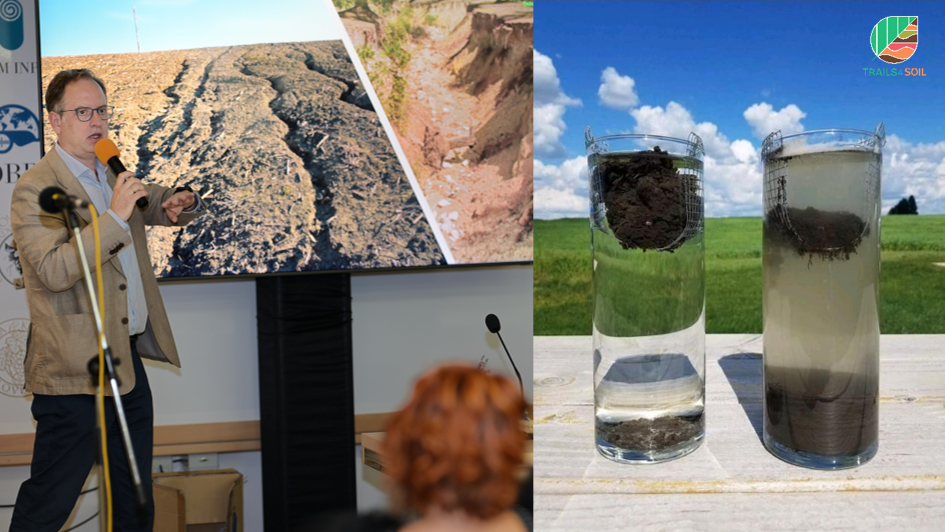
This is also directly reflected in water dynamics. Covered soils heat up less and lose less water through evaporation, while biopores in well-structured soil allow rainfall to infiltrate more rapidly.
│‘Our aim is to make use of every drop of water,’ he stressed.
The Spanish example: more than €700 million for a national programme
The Spanish example attracted particular attention because it illustrates the difference between fragmented support schemes and a nationally designed system.
As translated into Slovenian during his presentation, González Sánchez explained:
│‘More than €700 million has been allocated to conservation agriculture programmes. The programme has been designed at national level. Farmers growing either annual or permanent crops can apply. As a result, Spain now has almost five million hectares under conservation agriculture.’
He also sees the dissemination of practical examples as an advantage of this approach. The more farmers participate in the system, the easier it is for others to see a working example of the transition from conventional tillage in their own area.
His message to Slovenia was that it makes sense to pursue a shared national objective and avoid excessively fragmenting efforts across numerous disconnected measures.
TRAILS4SOIL: solutions must be developed together with farmers
A significant part of the presentation focused on the European project TRAILS4SOIL, involving the University of Ljubljana, SACA and Slovenian farmers.
The project is based on a different relationship between research and practice. ‘We do not want the university to dictate to farmers what they should do,’ González Sánchez said. Farmers, businesses and other stakeholders are therefore involved from the outset, because everything produced by the project must also be useful under real farming conditions.
The project will involve 100 farms across Europe. In Slovenia, the Living Lab will be led by the University of Ljubljana and SACA, with plans to include at least 1,500 hectares and 20 farms representing different types of production.
Experimentation, co-development and monitoring of results will be key components of the five-year project. Field days, seminars and training will also be organised, alongside information and technological solutions to support farmers through the transition.
The Ministry: healthy soils are a long-term investment
The agricultural policy perspective was presented by Dr Boštjan Petelinc, Head of the Department for Climate Policy in Agriculture at the Ministry of Agriculture.
In his words, agricultural soils are among the most important natural resources and underpin the long-term stability and resilience of Slovenian agriculture. Their role extends beyond food production: they retain water, mitigate the impacts of drought, enable nutrient cycling, conserve biodiversity and contribute to climate change mitigation.

He also highlighted the great diversity of conditions in Slovenia.
│‘Within our small country, we have five climate zones, and the soils are equally diverse. We can even have different soil types within a single field,’ he said.
Practices cannot therefore be applied indiscriminately across all farms. In his words, decisions must be based on professional expertise, research, soil monitoring and farmers' practical experience.
Climate pressures are not a distant prospect. Petelinc recalled that this year Slovenia experienced approximately four weeks with temperatures above 35°C, while three years ago there were floods.
│‘This is the reality in which we live,’ he stressed.
Healthy soils must therefore be understood as a long-term investment in the resilience of Slovenian agriculture, the competitiveness of farmers and food security.
More than twenty years without ploughing: Branko Majerič's experience
The theoretical foundations were then given concrete expression in farming practice.

Branko Majerič from Moškanjci, one of the pioneers of conservation agriculture in Slovenia, stopped ploughing in 2000. Several years of testing different approaches followed. In 2011, in cooperation with the Biotechnical Faculty of the University of Ljubljana, they began designing the current long-term trial and seeking suitable drilling technology.
Today, he farms approximately 35 hectares encompassing different soil types. It is precisely this experience that makes him sceptical of claims that conservation agriculture cannot be practised on all soil types.
│‘In my experience, that is not true,’ he stressed.
In his words, soil is an important carbon store as well as a water reservoir. If we continually disrupt the soil profile mechanically, we also disrupt the pore system that allows water to move towards the root zone.
The transition was not without uncertainty. Today, Majerič finds that yields are often the same or even higher. After ten years or more, the change in costs is even more apparent:
│‘If we analysed them in detail, we would see that they have fallen dramatically.
Fewer unnecessary tillage operations also mean less time spent on fieldwork and more time for other aspects of farm management, such as improving crop marketing.
Field measurements: two to three times fewer field operations
The experience from Majerič's farm is complemented by measurements from the research group led by Associate Professor Rok Mihelič.
After approximately ten years of monitoring, pronounced differences were observed, particularly in water infiltration capacity and structural stability. Soil organic matter content in the topsoil increased, as did earthworm numbers and microbial biomass.
According to Mihelič, when it comes to water, what matters is not only how much soil can theoretically hold, but above all how much rainfall it actually absorbs and retains in the root zone rather than allowing it to run off the surface.
The measurements also revealed specific differences in labour and energy use:
│‘We also measured this at Branko's farm. We recorded two to three times fewer field operations, with fossil energy use falling by roughly the same proportion.’
Over the long term, the machinery fleet required can also be reduced, along with capital or depreciation costs, as well as maintenance costs.
Žnideršič Organic Farm: closing the loop between soil, feed and livestock
A different but closely related experience was presented by Toni Žnideršič of Žnideršič Organic Farm in Črnec near Brežice.

They too began reducing tillage intensity approximately twenty years ago. Because of the heavy soils and the machinery available at the time, they opted for the shallowest possible tillage and, over time, began to observe changes in soil structure, the weed population and biological activity.
As a livestock farm, they produce almost all their own feed. Farmyard manure and slurry are returned to the fields, while primarily milk, meat and some grain leave the farm.
│‘Healthy soil, healthy feed, healthy animals. Everything is interconnected.’
They also apply conservation agriculture principles to grassland. One important change was a higher cutting height - above ten centimetres and sometimes as high as fifteen. According to Žnideršič, the sward became denser, while some species began to spread even without additional overseeding.
Farming in this way requires knowledge and continuous investment. According to him, they reinvest approximately 10 to 15 per cent of their income in development.
The key message from the discussion: conservation agriculture is a system
The discussion became most pointed on the question of future agricultural policy.

Majerič highlighted three principles that they seek to follow as consistently as possible on their farm: minimum soil disturbance, at least 30 per cent soil cover immediately after sowing, and a sound crop rotation.
The essence of his message, however, was that conservation agriculture cannot be reduced to a single operation. If we use conservation tillage on a field this year and plough it again the next, a long-term system of soil improvement cannot be established.
│We need a stand-alone measure. We cannot rely solely on isolated annual operations.’
In Majerič's view, such a system must be long-term: a farm should participate in it for at least ten years, while the system must allow agronomically sound flexibility.
If, for example, a farmer grows potatoes once every five or six years as part of the crop rotation and therefore does not achieve the usual level of soil cover during that period, this should not automatically result in a penalty.
He also used his own experience to illustrate the problems that arise when an administrative system fails to understand a farmer's agronomic intention. After harvest, he sowed a mixture, or catch crop, but the satellite monitoring system failed to identify correctly what was happening on the parcel.
│‘For these parcels, I received, or faced, a penalty of approximately €1,200 because they could not determine whether it was the main crop.’
His actual aim was to keep the land covered and protected.
│‘In my view, every field you see completely bare today is a shame,’ he added.
What should the proposal to the Ministry contain?
Dr Petelinc explained that the Ministry already supports various soil protection practices, including establishing green cover on arable land, conservation tillage and other environmental measures.
However, one of the key questions for any new system-wide measure will be the measurability of impacts.
The proposal must be designed on a sound technical basis, then assessed for financial viability and value for money, and underpinned by indicators and measurement methods. Area alone, the number of hectares or the amount of funding spent are not sufficient. Petelinc listed soil organic matter, soil structural stability, soil biological condition, water retention and other parameters as possible indicators.
This is precisely where SACA and its partners in the TRAILS4SOIL project intend to make an important contribution. Mihelič explained that they are developing a system for monitoring, reporting and verification of impacts, together with a tiered approach that could accommodate both beginners and the most advanced farmers.
He emphasised in particular: ‘This is not about ideology.’ In his words, conservation agriculture is based on three principles that are essential to sustainable soil management and can be incorporated into different production systems.
Organic, regenerative and intensively managed farms can all operate within these principles. What matters is not the name of the system, but how the soil is managed.
After 2027: the policy window is open now
One of the most important moments in the round-table discussion came with a direct question to Dr Petelinc: when can we realistically expect a public commitment to develop a stand-alone measure for conservation and/or regenerative agriculture after 2027?
Petelinc replied that now is a particularly opportune time. A new strategic framework is being prepared for the next seven-year programming period after 2027.
He described the window of opportunity in very concrete terms:
│‘If this year, or in the first half of next year, we fail to achieve what Mr Majerič is calling for, the next similar opportunity will not come until the following programming period, roughly seven years from now.’
│‘That is why now is the time to put this issue on the agenda,’ he added.
Majerič summed up the political dimension just as directly: the technical and practical arguments can be prepared, ‘but ultimately a political decision is also required’.
The practical experience therefore already exists, long-term measurements are under way, and European projects are developing new methods for monitoring impacts. The next step is a sufficiently well-founded and measurable proposal that can provide the basis for a future system-wide support framework.
The role of cooperatives and farmer collaboration
The discussion also highlighted the role of cooperatives and joint investment.
Toni Žnideršič, who is also President of the Brežice Farmers' Cooperative, identified several possibilities: sharing certain machinery, raising awareness and marketing produce under a brand associated with conservation agriculture.
│‘If you are not big, you have to be different.’
Given the structure of land holdings in Slovenia, smaller farms predominate; cooperation and market differentiation can therefore be important elements of future development.
Žnideršič also highlighted adaptation to drought. Irrigation is important, but cannot be provided across large parts of Slovenia or may be economically unviable. In his experience, conservation agriculture helps crops cope better not only with drought, but also with flooding and water and wind erosion, which may support more stable farm businesses over the long term.
Ten years since the association was founded in Vransko
At the close of the anniversary event, SACA presented a certificate of appreciation to Primož Žigon, the association's first President.

Looking back at the association's beginnings, Žigon recalled how approximately ten people had gathered in Vransko ten years earlier to establish it formally, although the idea had been developing for some time.
In his words, over ten years the association grew beyond its initial group of enthusiasts and became an organisation that is active internationally and participates in national and European projects.
Mihelič concluded on an optimistic note. If strong cooperation can be established between the association, farmers, experts and the Ministry, he sees scope for developing a successful shared approach and a system that will address conservation agriculture more comprehensively in future.
A decade behind us, a decisive period ahead
The event marking SACA's tenth anniversary showed that conservation agriculture cannot be a story of one machine, one tillage operation or one subsidy.
It is a long-term approach to soil management whose effects accumulate over many years. Slovenian experience shows changes in water infiltration, soil structure, biological activity, energy use and the number of field operations required. At the same time, practical experience shows that the system must be sufficiently flexible to reflect actual agronomic conditions, crop rotations and the specific characteristics of each farm.
An important part of the technical work is only just beginning: measurable indicators, a monitoring system, and a technically and economically sound proposal for future agricultural policy will need to be developed.
The policy window is open now.
The event's closing message was therefore also a clear call for continued cooperation:
│‘Future agricultural policy must be shaped together with those who cultivate, study and care for the soil.’
After the official programme, Professor Denis Stajnko of the Faculty of Agriculture and Life Sciences at the University of Maribor, a founding member of SACA, presented the work of the committee responsible for assessing machinery suitable for conservation agriculture. Participants were then invited on a guided tour of selected solutions and seed drills at the AGRA Fair.

The newly published Slovenian translation of the book Cover Crops, a practical guide to incorporating cover crops into agricultural production, published by Kmetijska založba, was also presented. We would like to take this opportunity to thank everyone involved in preparing and publishing the Slovenian translation, thereby helping to extend practical knowledge of cover crops among Slovenian farmers.
More about the book and Kmetijska založba: Kmetijska založba - Facebook
On this anniversary, we extend our sincere thanks to everyone whose knowledge, experience and participation in the discussion helped make the main event possible: Associate Professor Rok Mihelič, President of SACA; Professor Emilio Jesús González Sánchez, President of ECAF; Dr Boštjan Petelinc, Professor Denis Stajnko, Branko Majerič, Toni Žnideršič and Primož Žigon.
Special thanks go to Marjana Grčman for moderating and guiding the discussion, and to all visitors, members, partners and supporters who have helped shape the story of the Slovenian Association for Conservation Agriculture over the past decade.
Thank you to everyone who was part of SACA's first ten years. A new decade lies ahead - with the same fundamental aim: healthy, fertile and resilient soils for future generations.

Edited by:
Aljaž Novak, Slovenian Association for Conservation Agriculture (SACA).
Based on the transcript and presentation materials from the event.
Photographs:
Tomaž Škorjanc
Graphics:
from the presentation by Professor Emilio Jesús González Sánchez, where indicated.
Technical support for the event:
Matej Slana, Slovenian Association for Conservation Agriculture (SACA).


Comments